

How to Program a Transponder Key
Without the Original?
- Texas Premier Locksmith
- Serving All of Texas
 Licensed & Insured
- All Makes & Models
- Mobile Service to Your Location
- Available 24/7
 Licensed & Insured
 Published On:May 17, 2022

Last Updated:
Car theft has always pushed automakers to find smarter ways to protect vehicles, and the transponder key was one of the most effective answers to that problem. But as useful as this technology is, it comes with its own set of challenges, especially when something goes wrong.
If you are dealing with a transponder key that is not working, you basically have two options. You can call a licensed locksmith and have a professional sort it out quickly, or you can try to handle it yourself. Both are valid options depending on your situation. For drivers specifically looking for transponder key replacement in Dallas TX, we will cover that too before the end of this guide.
Before you decide which way to go, it helps to take a step back, it is worth understanding how transponder key actually works, what it involves, when a DIY approach is realistic, and when it is simply faster and smarter to call a professional automotive locksmith and let them handle it. Not every situation is the same, and knowing the difference can save you a lot of time and frustration.

How a Transponder Key Works
Before we look at solutions, here is a quick look at what makes a transponder key different from a regular one and why programming it is not as simple as cutting metal.
1
Built-In Microchip
Transponder keys contain a microchip inside of the plastic head and this microchip comes programmed with a unique identification code. Each chip carries a fixed or encrypted rolling code that is unique to your vehicle, which means no two transponder keys from the same make and model will share the same signal.
2
How It Communicates
This code communicates with your car’s computer or ECU (electronic control unit). When you use the right key, the car’s ECU authenticates the special signal transmitted by the microchip, and deactivates the engine’s immobilizers so that you can start your car. In newer vehicles, this process happens instantly, in a fraction of a second, through encrypted radio frequency signals.
3
When the Wrong Key Is Used
If you try to use a basic metal key or a wrong key (which is not synced to the car’s computer), then the immobilizer stays active and the engine won’t start. This is also why a perfectly cut duplicate key without proper chip programming will fail to start the vehicle.
4
What Makes It Theft-Proof
This security feature makes transponder keys highly secure as hot-wiring or using an unauthorized duplicate key without proper programming will not be able to bypass this smart electronic verification process. This is why losing your transponder key can be troublesome. Most modern vehicles also use encrypted transponder systems that rotate or scramble the signal, making them significantly harder to clone than older fixed-code keys. Some modern systems also log key activity, which can help identify unauthorized access attempts.
5
Transponder chip key replacement
Transponder chip key replacement is not as simple as getting a standard key copied at a hardware store. The physical cut must match your ignition, and the chip inside must be electronically paired with your vehicle. Both steps have to be completed correctly, or the car will not start.
Smart Keys and Proximity Keys Work Differently
While traditional transponder keys need to be physically inserted into the ignition, modern smart keys and proximity keys work differently. They communicate with your vehicle using a continuous low-frequency radio signal, allowing the system to detect when the key is nearby. That is what enables push-to-start ignition without turning a key.
Unlike standard transponder chips that draw power from the vehicle’s ignition coil, smart keys and fobs rely on their own internal battery. Because of this, if the battery dies, the key stops communicating with the vehicle altogether, even though the key itself may still be perfectly intact.

Can You Program a Transponder Key Without the Original?
Losing your transponder key feels like a dead end, but it does not have to be. For certain older vehicles, there is a way to program a new transponder key even without the original. This guide explains what that involves and how to work out whether your vehicle is one of them. Keep in mind that you will still need a new key cut to fit your ignition before any of this will work.
The relearn method described below works only on certain older vehicles that have this type of key relearn built into them. It does not require diagnostic software, but the timing and steps vary between vehicles, so the procedure must match your exact make, model and year. While it may sound like a straightforward process, it does not work for every vehicle.
Whether it works or not depends heavily on the make, model, and year of your car. If the steps below do not apply to your situation, or if you have already tried and hit a wall, working with a licensed locksmith who specializes in car key programming without the original is often the most reliable next step.
Let’s take a look at the necessary steps.
What It Takes to Program a Transponder Key Without the Original
Some older vehicles include an owner relearn procedure, but support depends on the exact make, model, year and key system. Check the owner manual or manufacturer information before attempting it.
1
What the relearn process actually is
Some vehicles can recognize a compatible key through a built-in relearn procedure, without separate diagnostic equipment. It is not a bypass or an online trick, and it does not work on every vehicle. It only works when that option was built into your specific vehicle.
2
How to find out whether your car supports it
The procedure, the waiting times and the dashboard security light you need to watch vary from one vehicle to another. That is why you should not follow a generic version or use instructions written for a different model. Check the owner’s manual and the manufacturer’s information for your exact vehicle. If you cannot find a procedure that clearly matches it, confirm with the manufacturer, a dealership or an automotive locksmith before starting.
3
What you still need before you start
This process only lets the car read the chip inside the key. It does not cut the metal blade, and it cannot make the wrong key work with your vehicle. You must already have a key that has been cut correctly and contains the right chip for your vehicle. Using an incompatible key is one of the common reasons people complete the entire process and still cannot start the car.
3
When to stop
If the security light does not behave the way the correct instructions describe, stop there. The vehicle battery may be weak, the key may be incompatible, the procedure may be wrong for your model, or the vehicle may not support this method at all. Repeating the same sequence will not solve any of those problems. On some vehicles, repeated failed attempts may also prevent another attempt for a period of time.
4
The honest summary
This process is real and can work when the vehicle was designed to support it and the correct key is being used. On vehicles without that option, the new key has to be connected to the car’s computer using professional programming equipment. An automotive locksmith can check the year, make, model and key type and tell you which method your vehicle requires before anyone comes out.
Expert Tip
Pairing a new key like this usually disables any old keys that were linked to the vehicle. Even if you find the original key later, it likely won’t work anymore after the new one has been programmed.
It’s always a good idea to get a spare transponder key made while you still have a working one in hand. Adding a spare is usually quicker, easier, and costs far less than starting from scratch if you lose your only key. It may not feel important now, but it makes a big difference when you actually need it.
When the DIY Method Does Not Work
The relearn procedure above works on a limited number of vehicles, mostly older vehicles, primarily domestic models, that support a timed bypass window. If your transponder key is not working after following these steps, or if the process does not apply to your vehicle at all, you are not out of options, but you are at the point where professional tools become necessary.
Here are the most common situations where the DIY approach will not get the job done:
- Your vehicle is a 2010 or newer model. Most modern cars use encrypted transponder systems that require dealer-level or locksmith-grade programming software to pair a new key. The timed bypass method does not work on these vehicles. The cutoff year varies by manufacturer, so if you are unsure, check with a locksmith before attempting the process.
- You have lost all keys and do not have a working key. Some programming sequences require at least one functioning key. When all keys are lost, car key programming without original access typically requires direct communication with the ECU using specialized equipment.
- Your vehicle uses a proximity key, smart key, or push-to-start system. These are not standard transponder keys. They operate on more advanced communication protocols and cannot be programmed using the same manual methods. If your car starts without inserting a key, you have a proximity or smart key system, not a standard transponder key.
- The security light does not respond as expected. Common causes include a weak car battery, a damaged key blank, or a vehicle that simply does not support the bypass method. In any of these cases, a locksmith can run a proper diagnostic before cutting or programming anything.
- You are driving a vehicle from a European or Japanese manufacturer. Many of these brands, including BMW, Mercedes, Toyota, and Honda, use proprietary immobilizer systems that require brand-specific programming tools not available outside of dealerships and licensed locksmiths.
When something doesn’t work, the right move is to stop and call a licensed automotive Dallas locksmith rather than risk making the situation harder to fix. A professional can assess your specific vehicle, confirm what is possible, and complete the programming on-site without requiring a tow to a dealership.
Here is what actually happens when a professional automotive locksmith handles a transponder key replacement:
Many drivers assume that transponder key programming is a simple task. In reality, it involves several steps that require specific tools, hands-on training, and access to vehicle data that most people simply do not have.
A qualified car locksmith in Dallas handles this kind of work daily, which is exactly what separates a properly programmed key from one that fails at the ignition.
Here is what a qualified automotive locksmith typically handles during a transponder key replacement service:
1
Key Cutting
Before any programming can begin, a new key blank has to be cut to match your ignition and door locks precisely. Locksmiths do this one of two ways: by pulling the key code from a database using your VIN, or by taking direct measurements from the lock cylinder itself. Both methods work, but not every vehicle’s key code is publicly accessible, which is one reason why not every locksmith can service every vehicle.
When there is no original key to copy from, the cut has to be right the first time. A key that is even a fraction off will either not turn at all or create wear on your ignition cylinder over time, which turns a simple key replacement into a much bigger problem.
2
Chip Identification and Key Blank Selection
Not all transponder chips are the same. Different manufacturers use different chip technologies, and selecting the wrong blank will produce a key that looks and feels identical to the right one but cannot be programmed no matter how correctly the software is applied.
A professional, experienced locksmith identifies the correct chip type for your specific make, model, and year before ordering or cutting the replacement. It sounds like a small detail but it is not and that is where a lot of poorly done jobs fall apart.
3
ECU Pairing and Transponder Programming
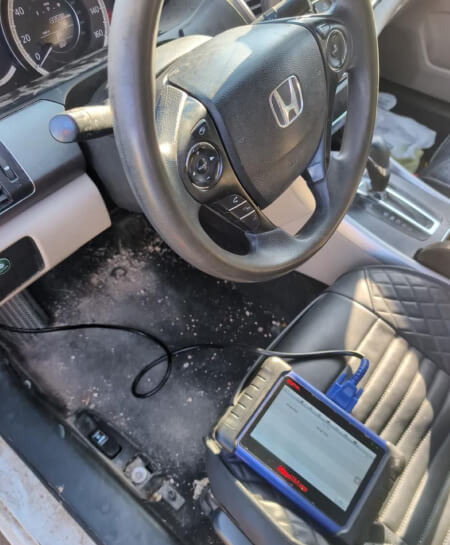
This is core of transponder key programming job. Using professional diagnostic software, the locksmith communicates directly with your vehicle’s ECU and registers the new key’s chip code as an authorized signal. For most situations where a spare key exists, this is relatively straightforward.
When no working keys remain, the locksmith has to run a full all-keys-lost procedure, which removes every previously registered key from the vehicle’s memory and enrolls the new one from scratch
This takes longer, costs more, and requires a higher level of access to the vehicle’s system. That is why we always recommend getting a spare key made before you ever need one. It is always worth it.
Pro Tip: Deleting Lost or Stolen Keys
Many vehicle owners do not realize that deleting a lost or stolen key from their car’s memory is even an option, but it is one of the most important steps in protecting your vehicle after a key goes missing. If your original transponder key was lost or stolen, it still exists in your car’s memory as an authorized key.
An experienced locksmith will always delete it from the system as part of the replacement job so that the old key cannot be used to start or access your car. If a locksmith does not bring this up, ask for it directly. It is a standard step and it only takes a few minutes, but skipping it leaves your vehicle only half protected, regardless of how good the new key is.
Need a Professional Locksmith for your transponder key challenges?
Certain vehicles simply will not respond to manual methods and often require advanced diagnostic equipment and programming software to get a new key working correctly. That is where a professional automotive locksmith in Dallas TX makes things simple. Our mobile technicians handle the entire process at your location, without the wait times and added cost of going to a dealership. We come fully equipped and get you back on the road without the hassle.
Dealing with a lost or non-working transponder key can quickly turn stressful, especially when your vehicle won’t start. Whether you need a new key programmed, a complete reset, or professional transponder key replacement in Dallas TX, getting it handled the right way matters. Texas Premier Locksmith saves you time, prevents costly mistakes, and gets you back on the road without the dealership runaround.
Need transponder key replacement? Call Texas Premier Locksmith
Whether you need lost transponder key replacement in Dallas, TX with no spare key available, or you simply want a duplicate made before an emergency happens, our licensed technicians handle transponder key replacement in Texas for most domestic and foreign vehicle makes and models.
Written By
TPL
Texas Premier Locksmith Team
Texas Licensed Locksmith, License #B17236The Texas Premier Locksmith team consists of licensed technicians with real experience handling lockouts, key replacements, and security upgrades across Texas. Our content is based on actual service scenarios, helping customers understand costs, processes, and what to expect before calling a locksmith.
“Texas Premier Locksmith is a licensed locksmith company in Texas (License #B17236) serving customers since 2011.”
Key Won’t Turn in Your Front Door Lock? Here Is What Is Actually Wrong
Residential · BLOGKey Won't Turn in Your Front Door Lock? Here Is What Is Actually Wrong Texas Premier Locksmith Serving All of Texas Licensed & Insured, TX #B17236 All Makes & Models Mobile Service to Your Location Mon to Sat, 7am to 10pm [post_updated label="Last...
Doorknob Turns But the Door Won’t Open? Here Is What Has Failed
Residential · BLOGDoorknob Turns But the Door Won't Open? Here Is What Has Failed Texas Premier Locksmith Serving All of Texas Licensed & Insured, TX #B17236 All Makes & Models Mobile Service to Your Location Mon to Sat, 7am to 10pm [post_updated label="Last...
How to Stop Package Theft at Your Front Door
Residential · BLOGHow to Stop Package Theft at Your Front Door Texas Premier Locksmith Serving All of Texas Licensed, bonded & insured TX License #B17236 Mobile service across Texas Mon to Sat, 7am to 10pm Why...
The Best Smart Lock for Your Corpus Christi Airbnb
Residential · BLOGThe Best Smart Lock for Your Corpus Christi Airbnb Texas Premier Locksmith Serving All of Texas Licensed, bonded & insured TX License #B17236 Mobile service across Texas Mon to Sat, 7am to 10pm [post_updated label="Last Updated:" format="F j,...
Texas Premier Locksmith



Frequently Asked Questions

Can a transponder key stop working even if it is not damaged?
Yes, and it happens more often than people expect. Sometimes the chip quietly loses its programming, and sometimes it is the antenna ring around the ignition starting to fail. Either way, there is nothing visibly wrong with the key. A lot of Dallas drivers call us assuming they need a full replacement when a simple reprogram is all it takes.
Why does my car key turn but the engine still will not start?
The cut is fine. The issue usually comes down to the chip. The immobilizer is not picking up the right signal, so it keeps the engine disabled. Mechanically, the key works. Electronically, it does not.
Can a locksmith make a key using just the VIN number?
Yes. The VIN can be used to retrieve the key code, and from there a new key can be cut without the original. That part is straightforward. What comes next is where things actually matter. The chip still has to be paired to your vehicle before it will start.
How long does it take to replace and program a transponder key on-site?
Most jobs take about 30 to 60 minutes. It really depends on whether you still have a working key. If you do, things usually move faster. If all keys are lost, resetting and programming the system takes a bit longer, but it is still handled on-site.
What is the difference between a transponder key and a remote key fob?
The transponder key is what lets the car start by sending the right signal to the system. The fob is what you use to lock or unlock the car from a distance. A lot of keys today do both, which is why people often mix the two up.
Is it possible to program a new key if the ignition has been replaced?
Yes, but everything has to be in sync. The replacement ignition needs to communicate properly with the vehicle’s system. If that connection was not set up correctly, the new key will not be recognized. Letting your locksmith know about the ignition change upfront helps avoid unnecessary delays.