

What Is a Laser Cut Key?
- Texas Premier Locksmith
- Serving All of Texas
 Licensed & Insured
- All Makes & Models
- Mobile Service to Your Location
- Mon to Sat, 7am to 10pm
 Licensed & Insured
Published On:September 22, 2021

Last Updated:
How Do You Know Which Kind of Car Key You Actually Have?
Most drivers carry their car key around for years without thinking much about it. It opens the doors, gets you home from work, and ends up in the same bowl on the kitchen counter most evenings. Then one day something goes wrong. Maybe the key snaps in the lock. Maybe the spare you have had in a drawer for years suddenly stops working. Or maybe a locksmith on the phone asks whether your key is laser cut or edge cut, and you realize you have no idea.
Below we walk through what a laser cut key actually is, what makes it different from the older style of car key, how to identify which one your vehicle uses, and what your options look like when you need a new one made.
How a Laser Cut Key Looks Different from a Regular Key
The older style of car key that most people grew up with is called an edge cut key. If you have ever made a copy of a house key at a hardware store, you have already used one. The cuts run along the side of the blade as a series of small jagged teeth, and any locksmith can duplicate the pattern quickly with a basic key cutter. You still see these keys on older vehicles, motorcycles, and some budget models, but most cars built in the last fifteen years moved on from them.
A laser cut key is shaped and cut differently. The blade is thicker, heavier, and the outside of the blade looks almost smooth. The actual cutting is a thin channel carved down the middle of the blade running along its length. Because that channel is mirrored on both sides, the key slides into the lock without you needing to flip it around. If you have a car key that you never have to turn the right way up before putting it in, it is almost certainly laser cut.
The plastic head on a laser cut key tends to be bigger too. There is usually a transponder chip housed inside, and on newer cars the head also contains the buttons for a remote fob or the antenna for a proximity smart key.

Why Carmakers Moved Away from Edge Cut Keys
The older edge cut design had been used since the early days of the automobile. It was simple to produce and worked well enough for several decades. By the late 1990s, that simplicity had turned into a problem.
Car theft was widespread through the 1980s and 1990s, and the lock and key design was part of the reason. Edge cut keys could be duplicated at a hardware store in a couple of minutes. Hotwiring was still possible too, which meant a car could be stolen without any key at all.
Laser cut keys changed several things at once. The channel cut down the middle of the blade needed a precision milling machine, not a basic key cutter, which made casual duplication impossible. The blade itself was thicker and harder to bend, break, or pick. The mirrored cuts on both sides also gave the lock cylinder more reading points along the length of the channel, so the security was tighter all the way around.
Transponder chips were becoming more reliable around the same time, so carmakers paired the new blade design with a small chip inside the plastic head. The blade still turned the lock, but the chip had to send the right signal to the car’s immobilizer before the engine would start. A thief who somehow copied the blade still could not start the car without the matching chip.
Almost every truck or SUV sold in Texas in the last ten years uses a laser cut key. Most passenger cars from Honda, Toyota, Nissan, and the rest of the major manufacturers have used this design for years too.
Expert Tip
A laser cut key is not always the same as a smart key. The cut is the metal. The chip is the electronics. You can have one without the other, which is why two keys that look almost the same can have very different replacement prices.
How a Laser Cut Key Compares to a Transponder Chip Key
These two keys do different jobs, and most modern cars actually rely on both of them working together rather than one or the other.
A laser cut key is the mechanical side of the system. Its job is to physically open the lock and turn the cylinder. The shape of the blade has to match the cut pattern of the lock for the cylinder to turn at all. This is the part a locksmith is referring to when they talk about cutting a key, and it is the part that wears down with daily use over the years.
A transponder chip key is the electronic side. The chip sits inside the plastic head, and every time you put the key in the ignition or hold the fob close to the car, the chip exchanges a coded signal with a receiver near the steering column. The vehicle’s computer compares that code against the keys it has been programmed to accept. If the codes match, the engine starts. If they do not, the engine stays locked even when the blade turns the cylinder perfectly. This is why a freshly cut blank from a hardware store can turn the lock without ever starting the car. The metal is right, but the chip is missing. If you want to understand the chip side of the system more closely, our piece on how a transponder chip key works walks through the signal exchange in detail.
Where this really matters for you as a driver is cost. A pure laser cut key with no chip is the cheapest to replace because the locksmith only has to reproduce the mechanical cut. A laser cut key that also carries a transponder chip costs more because the chip has to be programmed to your vehicle in addition to cutting the blade. A smart key or proximity fob, which uses the same chip technology but in a more advanced package, costs more again because of the additional electronics.
Most modern laser cut keys do come paired with a transponder chip. Some older laser cut keys from the early 2000s are mechanical only. Newer keys on premium vehicles often use proximity sensors, rolling encrypted codes, and keyless start functions.
Not Sure What Kind of Key Your Car Uses?
If you are looking at your key right now and cannot tell whether it is laser cut, transponder, or both, the easiest way to get a clear answer is to send us a photo. Our team can usually identify it in a few minutes and walk you through what a replacement would actually involve, so you know what you are dealing with before any technician comes out.
A Few Quick Ways to Identify What You Have
A few simple checks will give you the answer, most of which you can do without leaving your seat.
- Look at the blade. If the cuts are smooth along the outside and the actual cutting runs as a line down the middle of the blade, the key is laser cut. If the cuts are along the sides of the blade in a jagged tooth pattern, it is an edge cut.
- Feel the weight. A laser cut blade is heavier and sturdier than the older style. Set one next to a typical house key and the difference is immediate.
- Look at the year of your vehicle. Most cars built after the mid 2000s and almost all trucks built after 2010 came factory equipped with this style. Anything older than that is more likely to be edge cut.
- Consider the make. European brands like BMW, Mercedes, and Audi moved over to laser cut keys earlier than American brands, but at this point nearly every major manufacturer has adopted them across most of the lineup.
If you are still unsure, take a clear photo of the blade and the head of the key and send it over to a locksmith. We can usually identify the design within seconds, and most Texas shops will give you the answer over the phone before sending a technician out.
Red Flag
If your key has started sticking in the cylinder, turning slowly, or you find yourself jiggling it before the engine fires, the blade may be wearing down. Laser cut blades are cut to fine tolerances, and even a small amount of wear on the channel can stop the key from registering properly with the lock.
Why a Hardware Store Cannot Make You a Copy
You walk into a hardware store with your car key, expecting them to handle it the same way they handle your front door key, and the person at the counter tells you they cannot help. It is one of the more confusing moments people have with a car key, and it always comes down to the same thing.
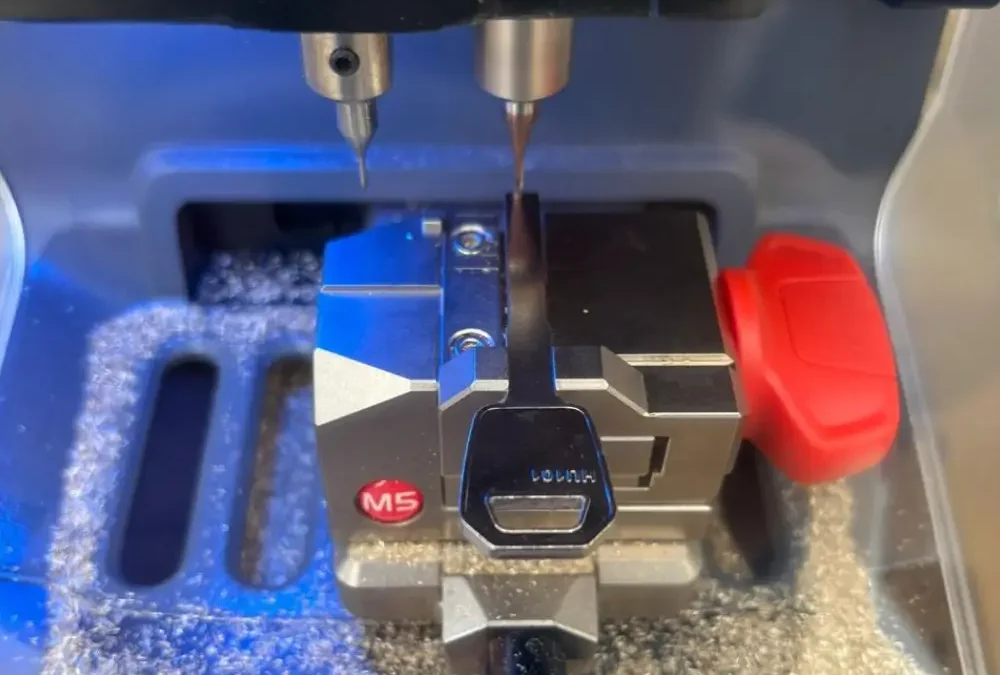
Cutting a laser key takes a precision milling machine that costs several thousand dollars and requires trained operation. The cut has to be precise enough to work in both the door lock and the ignition, which are read slightly differently. That kind of accuracy needs the right machine and someone trained to use it.
A standard hardware store key duplicator is a much simpler machine. It can copy basic edge cut keys, the same kind used on house doors, padlocks, mailboxes, and older vehicles. It cannot cut the deep center channel that a laser key requires.
A lot of general locksmiths do not handle laser cut work either. The equipment is a real investment, and you typically need an automotive specialist who has chosen to make it. If a shop tells you they cannot cut laser keys, that usually means their setup is built around house and commercial work rather than modern vehicles, not that the job itself is unusual.
What to Do If Yours Is Lost, Broken, or Worn Out
A new laser cut key can be made even if you have lost every copy you had, and a broken or worn key can be replaced quickly if you still have a spare to work from. The process depends on what you still have.
If you still have a working key, the locksmith uses it as the reference to cut and program a new one. This is the quickest way to handle it. The new key is matched to the original in minutes and tested before the technician packs up.
If you have lost every working key, the job takes longer. The cylinder has to be read directly to generate the cut pattern from scratch, then a fresh blank has to be paired to your vehicle’s immobilizer if there is a chip involved.
When you call, it helps to have a few things ready:
- The year, make, and model of the vehicle
- The Vehicle Identification Number, usually visible on the dashboard at the base of the windshield or printed inside the driver’s door frame
- Your registration or some other proof of ownership
- The current location of the vehicle
If you’ve actually lost your keys right now, our guide on replacing lost car keys covers every part of the process from the first phone call to driving away.
Expert tip from our automotive team:
Before you call, snap a quick photo of your VIN through the windshield. It is faster than reading the long string of letters and numbers out loud, and it lets us check what type of key your car uses ahead of time. That way the technician arrives with the right blank and the right tools the first time.
What a Replacement Usually Costs
A basic laser cut blade with no chip lands in the lower end of the price range. A laser cut key with a transponder chip costs more because the chip has to be programmed to your vehicle. A smart key or proximity fob can run noticeably higher because of the electronics involved. The vehicle year, the make, and whether the job happens during business hours or after will also move the final price. For a full breakdown, see our guide to laser cut key replacement cost.
Need a New Laser Cut Key Made Today?
Keys wear down. Blades snap. Spares get lost in parking lots. Sometimes a lock just stops reading a key for no clear reason. Whatever you are dealing with, you do not have to drive across town to a dealership and wait days for an appointment.
The licensed mobile technicians at Texas Premier Locksmith cover the major Texas markets including Dallas, Austin, and Killeen, and travel out to drivers across the rest of the state. We come out with the equipment to cut and program the new key right there, test it in the door and the ignition, and hand it over to you knowing it works. Most jobs wrap up in under an hour.
For a full picture of what we cover on the automotive side, you can also look through our Texas automotive locksmith services.
Need a Locksmith to Cut You a New Laser Cut Key?
Whether your laser cut key has worn down from years of use, snapped in the lock, gone missing, or you simply want a spare made before you actually need one, we are happy to help. Our licensed technicians travel across the major cities and towns in Texas, and our mobile service brings the cutting and programming equipment to wherever you are. Give us a call and we will tell you what the job involves before sending a technician out.
Written By
TPL
Automotive team at Texas Premier Locksmith
Texas Licensed Locksmith — License #B17236
The Texas Premier Locksmith automotive team is a group of licensed mobile technicians who spend their days cutting keys, programming chips, and getting Texas drivers back on the road. We write these guides based on the questions our customers ask us most often, so that drivers have a clearer idea of what they are dealing with before they pick up the phone.
Car Key Fob Stolen? Does Reprogramming Stop It From Unlocking Your Car?
Automotive Locksmith · BlogCar Key Fob Stolen? Does Reprogramming Stop It From Unlocking Your Car? Texas Premier Locksmith Serving All of Texas Licensed, bonded & insured TX License #B17236 Mobile service across Texas Mon to Sat, 7am to 10pm [post_updated...
Why Does My Deadbolt Only Lock When I Push or Pull the Door?
Residential · BLOGWhy Does My Deadbolt Only Lock When I Push or Pull the Door? Texas Premier Locksmith Serving All of Texas Licensed & Insured, TX #B17236 All Makes & Models Mobile Service to Your Location Mon to Sat, 7am to 10pm [post_updated label="Last...
Key Won’t Turn in Your Front Door Lock? Here Is What Is Actually Wrong
Residential · BLOGKey Won't Turn in Your Front Door Lock? Here Is What Is Actually Wrong Texas Premier Locksmith Serving All of Texas Licensed & Insured, TX #B17236 All Makes & Models Mobile Service to Your Location Mon to Sat, 7am to 10pm [post_updated label="Last...
Doorknob Turns But the Door Won’t Open? Here Is What Has Failed
Residential · BLOGDoorknob Turns But the Door Won't Open? Here Is What Has Failed Texas Premier Locksmith Serving All of Texas Licensed & Insured, TX #B17236 All Makes & Models Mobile Service to Your Location Mon to Sat, 7am to 10pm [post_updated label="Last...
Texas Premier Locksmith



Frequently Asked Questions

Can I use a laser cut key in any direction, or only one way?
You can insert a laser cut key either way up. The channel running down the blade is mirrored on both sides, so the lock reads the cut whichever way the key goes in. It is one of those small things drivers stop noticing until they go back to an older key that has to be flipped around first.
Why does my laser cut key feel heavier than my old car keys?
Laser cut keys use a thicker blade than older edge cut keys. That extra metal helps the key hold up better over time and makes it harder to bend or snap. Older keys only needed enough material for the side cuts, while laser cut designs are built a little sturdier from the start.
Do laser cut keys ever wear out?
Yes, especially after years of daily use. The center channel is cut to fine tolerances, so over time the edges can wear down enough to affect how the lock reads the key. Usually the first signs are sticking, slow turning, or needing to jiggle the key before the ignition responds. If you still have a working spare, a locksmith can usually duplicate it before the worn key fully stops working.
Are laser cut keys harder for thieves to copy than regular car keys?
Yes. Cutting a laser key requires specialized milling equipment that most basic key copying setups do not have. Most modern laser cut keys also work alongside a transponder chip, so even if somebody copied the blade, the vehicle still would not start without the programmed chip matching the immobilizer system.